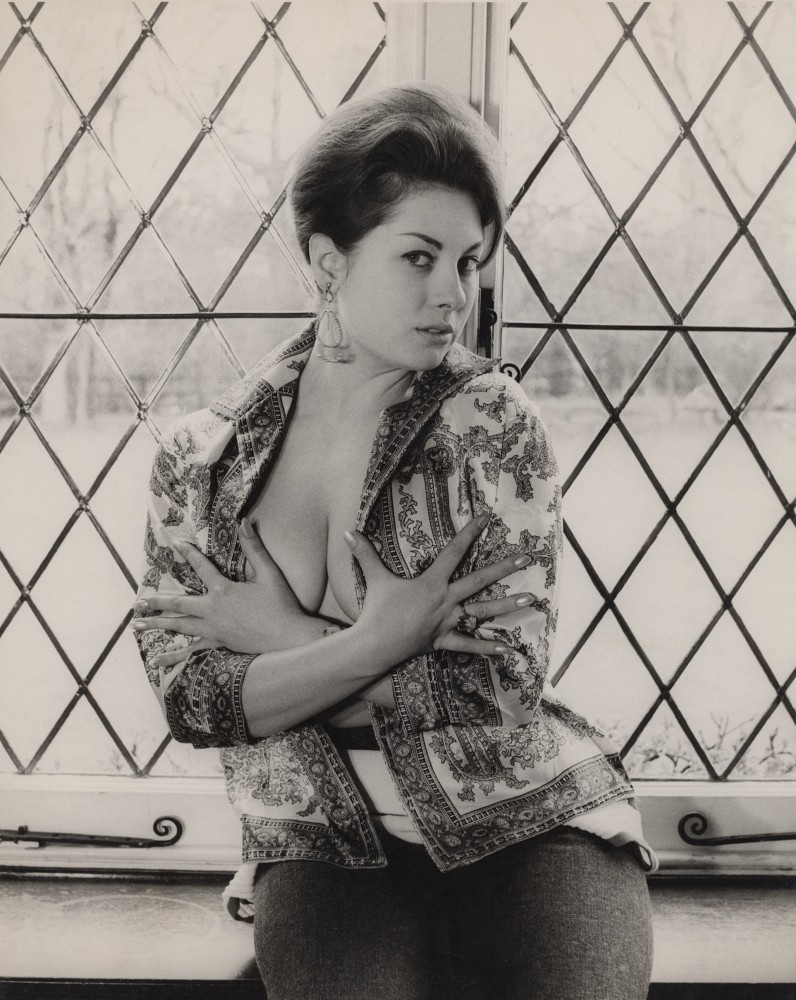
June Palmer

June Palmer 1960s Model

June was prolific, largely thanks to her association with George Harrison Marks, but she also appeared in many other publications and was still modelling professionally well into her forties for magazines such as Mayfair.

She was born June Margaret Palmer on 1 August 1940 in Bromley, Kent.

As is often the case, there are many contradictory stories about the details of her private life. Researching the past is full of possibilities and dead ends, and there will inevitably be differences of opinion. However, we can set the record straight on some points beyond any doubt.

We know from a copy of her marriage certificate that June was married on 7 November 1964 at the Chelsea Register Office, when she was a 24-year-old photographic model. The lucky man was 20 years her senior: 44-year-old photographer and stuntman Arthur Howell, a fascinating and charming man with an exciting and varied career. He was Michael Caine’s stand-in and a stuntman on several of the famous Bond films, and he was a familiar face on television, appearing in hit series such as Robin Hood and The Persuaders.


June and Arthur set up and ran Strobe Studios in Clapham, South London. It was a respectable business that hired out studio space to amateur and professional photographers alike, and supplied them with models from Strobe’s books, among them Mary Millington (under her married name, Mary Maxted).
June later divorced Arthur, who died three years after the divorce. In 1989 she married David C. Milan in Chelmsford, where she died suddenly in 2004.

June began her career as a topless dancer at the Windmill Theatre, where countless British starlets, actors and comedians cut their teeth. If that name means nothing to you, watch the film Mrs Henderson Presents, starring Judi Dench and Bob Hoskins.
She went on to appear in all of Harrison Marks’ magazines (Kamera, Solo and others) and in numerous 8mm glamour films made by him and others, before graduating to parts in mainstream films.
She was an extremely good-looking woman, and for me she looks her absolute best in some of the more candid, relaxed shots.


We have recently acquired a sizeable collection of prints and negatives of June, which we believe were taken by the little-known photographer Peter A. Quinn. Many may never have been seen before.

For more pictures and information on June Palmer, visit The Kamera Club and search for “June Palmer”, or go directly to her model page.

(Link to Print Sales)

(Link to Negative Sales)

1

Wet and Messy – Splosh!

Wet & Messy – Splosh! Magazine and the Birth of a Subculture

Splosh! holds a unique place in the history of British adult publishing. First released in 1989 and created by Clive Harris (better known under his pseudonym Bill Shipton), it became the defining magazine for Wet and Messy Fetishism (WAM). The publication featured playful photo sets and stories of models getting wet or messy with food, water, slime, pies and other harmless, tactile substances. It was light‑hearted, cheeky, and visually distinctive — and it was the first magazine to bring this niche out into the open.

Over its 40‑issue run, Splosh! grew into a full production house, releasing VHS and DVD videos and later expanding online. At its peak in the 1990s, the magazine had thousands of subscribers worldwide and was stocked in mainstream UK bookstores, making it one of the most visible fetish publications of its era. Many of its models went on to appear in video sketches and digital downloads as the scene evolved.

The WAM community itself is built around the sensory appeal of textures, colours and the visual fun of getting messy — often fully clothed, sometimes not, but always centred on harmless materials like custard, cream, mud or gunge. While the wider scene has since moved online, original print issues of Splosh! and similar titles have become highly collectible pieces of fetish history.

Wet and Messy – Sales Category

1

Utopian Press – Fads and Fancies

Fads and Fancies - Utopian Press

Utopian Press & Fads and Fancies: A Peek Into Bristish Mid‑Century Fetish Publishing

For collectors of vintage erotica, glamour magazines, and mid‑century curiosities, few names spark as much interest as Utopian Press. What began as a modest science‑fiction pamphlet publisher under the direction of Benson Herbert soon evolved into one of the most inventive — and mischievous — operations in post‑war British print culture.
Herbert, already an experienced publisher, clearly had an eye for the risqué. Even his early sci‑fi covers leaned toward pin‑up styling, hinting at the direction he would eventually take. By the late 1940s he had abandoned science fiction entirely, turning his attention to producing saucy, light‑hearted magazines at a time when British publishing laws made such ventures nearly impossible.
New periodicals were prohibited, so Herbert simply refused to publish a “periodical.” Instead, he released each monthly issue under a completely different title — a clever loophole that produced a parade of wonderfully named one‑offs: Carnival Capers, Sporty Stories, Blue Stories, Haywire, Snap, Cuban Capers, Hubba Hubba, Heebee Jeebee, and more. Each stood alone, yet together they formed a distinctive body of work that collectors now treasure.

The Birth of Fads and Fancies

Among Herbert’s creations, one title rose above the rest: Fads and Fancies.
It began quietly in January 1950 as a supplement inside Sporty Stories, then appeared in several other monthlies before being published independently in June 1950. The numbering was eccentric — the first standalone issue was labelled Volume 1 No. 6 — but this only adds to its charm today.
What truly set Fads and Fancies apart was its artwork. The magazine was lavishly illustrated by Reina M. Bull, signing as RMB and, within this series, as Janine. Her drawings of women in stockings, corsets, bloomers, hats, heels, lace, bows, and ruffles created a theatrical, highly adorned femininity that remains instantly recognisable. Her style is playful, elegant, and unmistakably mid‑century.
The written content came almost entirely from readers. Letter after letter — numbered for reference — explored the fashions, fascinations, and personal preferences of the era. Topics ranged from underwear and hosiery to skirts, jewellery, cosmetics, hobble skirts, garters, and even horses. It’s a vivid snapshot of post‑war British interests, expressed with a mixture of enthusiasm, humour, and discretion.

A Glimpse Into the Editorial Voice

A charming start to it all is Benson Herbert’s editorial introduction. In it, he welcomes readers to the first full issue, explains the mix of art paper, and gently reminds contributors that censorship rules sometimes forced him to alter or omit letters.
He notes, with a wink, that the magazine contains “nothing professional at all” — everything was written by readers themselves. It’s a rare moment of transparency and warmth from a publisher navigating a maze of restrictions while still trying to give his audience something fresh, playful, and personal.

Why Collectors Love These Today

Original Utopian Press titles are now increasingly rare. Their scarcity, combined with their quirky publishing history, distinctive artwork, and candid reader‑driven content, makes them highly desirable for collectors of vintage erotica and mid‑century print culture.
Each surviving copy is more than a magazine; it’s a small, rebellious piece of British publishing history.

Utopian Press – Fads and Fancies – Sales Category

1

Soho Typescripts and Handmade Publications

Soho Typescripts and Handmade Publications

I recently acquired a small collection of Soho typescripts and handmade publications from a private collection. Their content is dubious to say the least.

Soho typescripts from the 1950s and 60s. They were typically typewritten and then stencil-duplicated before being stapled into card covers.

These books were sold from the back rooms of Soho bookshops and under the counter by other second-hand dealers. They were popular and expensive at the time, but few remain today. Content typically consisted of two or three pornographic stories, often accompanied by drawings and photographs that were frequently unrelated to the narrative.

Content was very varied, with some of it being very questionable indeed. Popular topics included teenage sex, flagellation, lesbianism, femdom, and straight sex, but often at the extreme end of what might have been considered socially acceptable at the time, with a great deal of it definitely not acceptable in today’s world.

Most of these have now long disappeared into dark cupboards or have just been destroyed, and so are now very collectible. Some research on their origins and content has been done from a social history point of view. If you are interested in digging deeper, then check out the links below.

The Secret Porn of Post War London – The Soho Bibles.

Taylor & Francis – Porn Studies, available online here.

2

Harmony Communications 

Bondage Life - Harmony Communications

The Bondage Company.

Monthly magazines, films, and video cassettes featuring fully dressed, semidressed, or fully undressed ladies in tight, scrumptious “Love Bondage.” For the truly finicky, there are whole photo sections of bathing cap bondage, tennis shoe bondage, cheerleader bondage, and all the other bondage fantasies Harmony has managed to hear about and then portray.

To keep customers apprised of what’s old and new in the Harmony inventory, a free, lavishly illustrated catalogue sheet is sent out like clockwork each month to the company’s mail-order buyers. 

Since 1976, Harmony has been earning the approval of bondage lovers by not only producing its own contemporary materials, but also reprising the classic “Damsels in Distress” photo collections of pioneer bondage producers Irving Klaw and John Willie. Harmony has also published full magazine retrospectives of the complete photo collections of such celebrated mail-order bondage stars as Lyndia, Cheryl Rothman, Sally Roberts, Joanne Link, Judith Wilson, and others.

Most of Harmony’s magazines, films, and videocassettes are devoted to pictures of pretty women tied up and gagged in either their underwear or various bondage costumery, although there is also a generous quantity of fully nude bondage magazines in the Harmony output. Whatever the visual content, Harmony avoids offering anything that smacks either of violence or tastelessness, doting instead on its soft “Love Bondage” theme in which the Bound Beauty is characterised as an accomplice with her lover in a mutual act of pleasant foreplay. With Harmony, the pretty lady is all tied up because she wants to be.

One of Harmony’s accessory materials are the storyline videocassettes from Arrow, which star Sally Roberts and Susan Blair. So far, Harmony has been releasing one of these hour-long videocassette programmes each month.

If bondage is one of your pleasures, you should request being placed on Harmony’s monthly mailing list (you must send $3 and buy at least two Harmony publications every six months to remain active). Send Harmony the $3 for current catalogues, a signed statement that you are 21 years old or older, aware that you are requesting sexually oriented material, and that you want those monthly brochures.

Box 780 North Hollywood, California 91603

The AI Summary

Harmony Communications was a prominent publisher of fetish, BDSM, and bondage magazines based in North Hollywood, California, during the 1970s and 1980s. Founded by Robert Q. Harmon (who was also associated with Harmony Concepts Inc.), the company specialized in high-quality, photographic, and editorial content focusing on bondage, particularly in magazine, tabloid, and special issue formats. 

Key Publications and History

Bondage Life: The company’s flagship publication, titled BONDAGE LIFE; The Magazine For and By Bondage People, ran for at least 85 issues beginning around 1976/1977 and continuing through the 1980s and into the 1990s. It featured b/w and color photography, reader letters, fiction, and articles.

Other Titles: Harmony Communications released a variety of niche bondage magazines during the 70s and 80s, including:
Bondage Fantasies (1991)
Love Bound (1970)
DeSade Journal (1977)
Uptight (1982)
SWAT – Spanking (1978)
Bondage World (HCI)
The Bound Beauties of Harmony (1980)
Simone Devon’s Favorite Bondage Models (1988)
Woman/Slave (1982)

Production Context: The magazines served as a marketing and documentation vehicle for the videos and photo shoots produced by Harmony Concepts, frequently featuring popular fetish models of the era, such as Jennifer West, Libby Curtis, and Juliet Maitland.

Content and Style: Many issues contained 64-80 pages, using a mix of b/w and color photographs. They catered to a dedicated, mostly mail-order audience, providing a “behind-the-scenes” look at the bondage photo industry. 

Robert Q. Harmon is often credited with creating and publishing these magazines, making Harmony Communications a significant player in the niche erotic publishing scene of the 1970s and 80s. 

Fetish Times – The World’s Most Outrageous Newspaper

Fetish Times - The World’s Most Outrageous Newspaper

Whether you like licking bathroom floors, tying up transvestites, electrical torture, the joys of castration, panty pooping, labia piercing, human sacrifice to cannibal girls, enemas, amputees, or being fist-fucked while sky diving over shark infested waters – The Fetish Times caters to all ‘deviated perverts.’ Published once a month and sold for $1.50, it contains such popular departments as On the Rack – reviews of books, magazines and products; Reel Torture – film reviews; and It’s Our Bag – a column for enema lovers.

Appropriately billed as ‘the world’s most outrageous newspaper, The Fetish Times combines fact, fiction, reader’s true experiences, hard news, tips on new B&D techniques, and humor and satire in its heady brew of popular perversion. People who subscribe to the paper write about one-third of the articles. The letters to the editor are claimed to be written by real people, and most of the classified ad section is paid for by people who need other people and are willing to run an ad. Life is just a bowl of people.

Fetish Times - The World’s Most Outrageous Newspaper.

The AI Summary

Fetish Times – The World’s Most Outrageous Newspaper. I don’t think there are many that would disagree with that.

A niche adult tabloid publication focused on BDSM, bondage, and fetishes, published by B&D Company in Van Nuys, CA, during the mid-to-late 1970s and 1980s. Edited by Marvin X (often credited as “Master”), the paper featured explicitly themed content, including pictorials and articles catering to specific, extreme fetish interests. 

Publication Era: Active issues are found dating from at least 1975 through 1987.
Editor: Marvin X (Marvin E. Finkelstein) was the primary editor, often using the moniker “Master”.
Publisher: Produced by B&D Company, a specialist in fetish and bondage materials.
Scope: Issues were numbered sequentially, with examples ranging from No. 023 in 1975 to No. 154 in 1987. 

Fetish Times operated as a specialised publication for the adult industry, focusing on the growing, alternative sexual subcultures of that era.

If anyone has any of the newspaper copies, then I would be interested in purchasing them. Contact me!

Belier Press and Sweet Gwendoline

Bizarre Comix and Belier Press

I have a few magazines from the 1970s,  which I have copied over the years. They contain various reference information and articles about publishers’ titles and movies at that time. I would like to share some of this information here for your reference and enjoyment.

Some of the fetish and bondage magazines published in the 1970s are truly outstanding, and there’s nothing quite like them nowadays.  What’s available online simply doesn’t compare to the effort and craftsmanship of a magazine that took weeks to produce. I’m fortunate enough to handle these magazines most days, and I know there are many collectors with a wealth of knowledge. 

I’m hoping to jog a few memories, reignite your interest, and perhaps inform younger collectors about some fantastic publications.  To get started, I’ve included a two-page article about Belier and Sweet Gwendoline extracted from Volume 1 No 2 of The Bondage Buyers Guide & Almanac (1978).

Belier

No flaws here—this is a superbly intelligent company whose faith in the late John Willie has helped it escalate into a position of preeminence within the bondage publishing field.

For if there is a bondage classic which exceeds all others, it is Willie’s venerated “Sweet Gwendoline,” a deliciously witty and exquisitely done melodrama which Willie drew during the postwar 1940s. 

And, even though the original “Gwendoline” has been rephotographed and reissued through the years on the order of a best-selling cookbook, its popularity only seems to increase. What Belier has done, with painstaking care and an apparent measure of affection, is launch “Gwendoline” to her ultimate apogee as a large hardcover book, lovingly fleshed out to 144 pages with various other Willie drawings, including some watercolours, plus compelling text material both by and about Willie. Thus far, according to a Belier spokesman, 11,500 copies of the hard-bound “Gwen” have sold since it first went on sale on 9 December 1974.

If Belier has thus become Willie’s amanuensis, it plans on being not less so for other noted bondage cartoonists, including Stanton, Eneg, Maria, and Jim, for whom Belier has produced some revivals: 

Bizarre Comix Volume 1 contains two complete Stanton serials (“Diana’s Ordeal” and “Perils of Diana”), Bizarre Comix Number 2 covers the same ground on behalf of artist Eneg, the serials in this case being (“Princess Elaine’s Terrible Fate” and “Dangerous Plight of Princess Elaine“). The four serials date back to the early 1950s.

Belier plans to continue issuing Bizarre Comix in order to reprise long-dormant and out-of-print bondage drawings. Meanwhile, if you do not yet have “Sweet Gwendoline” in your collection, you are depriving yourself of the probable masterpiece of the genre.

This article was written in 1978 and has been extracted from The Bondage and Buyers Guide & Almanac – 1978. 

Belier Press and JB Rund eventually published 24 volumes of Bizarre Comix. See some of those books here.

3

Burmel Publishing

Burmel Publishing - New York 1960s

I have recently listed a number of books from Burmel Publishing for sale. These books are often hard to find and are becoming very collectible, for good reason in my opinion. Most of them are now around 70 years old, so the condition can be mixed. It’s important to read any attached notes to their general condition. 

For those unfamiliar with Lenny Burtman and Burmel Publishing, I’ve compiled a brief history below, mostly based on my own research books.

Burmel Publishing, founded in New York by Lenny Burtman in 1951, saw its first publication, Exotique, hit the streets that same year. This A5 digest-size magazine featured striking, powerful women dressed in leather, nylon, and satin, with impossibly high heels. Inspired by earlier magazines like John Willies Bizarre and the UK published Fads and Fancies, Exotique was illustrated by Gene Bilbrew, while Burtman focused on photography.

Burmel Publishing also published other notable titles, including Extatique, Fantastique, and Masque. However, with more copycat magazines appearing in the early 1960s, Exotique eventually folded. Despite this, Burtman’s publishing career continued. He renamed the company Selbee Associates, which went on to publish some of the best full-size glossy magazines throughout the 1960s and 70s. These included titles like Satana, Leg Show, and High Heels.

God bless Lenny Burtman I say.

Burmel Publishing Sales

Saucy Lenticular Cards

Saucy Lenticular cards 1950s and 60s

I recently acquired a small collection of books that included some 3D and lenticular cards, which I’m not particularly knowledgeable about. Although information was scarce, some were branded, which proved a helpful starting point. After some research and gathering information from various online sources, I’ve pieced together what I could find below.

 Lenticular cards, often called ‘winky’ cards, feature pictures that change as you flex the card to different angles. The technique of cutting and splicing layers of plastic pictures existed since the late 1800s, but gained popularity for cards in the mid-1900s. Many of these sets are highly collectable, ranging from baseball cards to Disney, landscapes, and special interest cards. More recent franchises include the Harry Potter series.

The sets I have are largely of Japanese origin, featuring girls in innocent poses that become less innocent as you move and angle the card. They capture the post-war interest in Japanese erotica, tailored to a more Western market. There were two main manufacturers of these postcards, both based in Japan.

The Toppan Top Stereo Glamour Postcards, famously identified with the “PK” code, were produced in the 1950s. Part of a series of Japanese erotic photography, these postcards were produced by Toppan Printing Co (now known as Toppan Digital Inc), a company based in Tokyo. They were distributed by Printing Studio AG, Zurich.

The Asahi Trading Co. was based in New York.  Their lenticular erotic pin-up cards were produced by Wonder Co. in Tokyo. These cards date from the mid-60s, possibly into the early 70s, and were likely produced specifically for the American market, given the high interest in Japanese art and goods during that time.  

Interest was also high in Europe, especially in Germany, where some cards were produced at around this time. This collection includes some non-branded cards, which are mostly likely Japanese in origin.  

They are now all available to purchase, and I’ve tried to illustrate the changing image. (Link directly to them here)

Atomage an Interview with John Sutcliffe

A friend of mine recently found a copy of Knave, published in November 1977. It includes a lengthy and interesting interview with John Sutcliffe (Atomage). Some of you more committed collectors may have already seen this, but if not, it’s worth a read. John’s perspective on fetishes is informative and interesting. The world would be a much better place if we were all a little more open and forgiving.

All text is an exact extraction, but some of the photographs have been added by me. For more information and lots of pictures, The Atomage Magazine Appreciation Site is always worth a visit. 

Editor Exposed – Extracted from Atomage No 18 (1978)

John Sutcliffe - Atomage Leather and Rubber Fetish Clothing

Being rather shy and diffident, John Sutcliffe has never sought the limelight even in the pages of this, his own, magazine. It needed the skill of another editor to do a profile which, under the heading ‘Johnny Sutcliffe, Man of Leather’, was published in Knave at the end of last year. Although still smarting at being called ‘Johnny’, he is quite pleased at having his life history printed, warts and all.

Derek Bowskill, who conducted the interview, observed that as he was dealing with an “off-beat aspect of human behaviour,” he expected to meet a character to match. “It was, therefore, a completely unexpected pleasure to discover that these traits were quite alien to Johnny Sutcliffe. He was gentle, quietly spoken, well educated, intelligent, courteous to a fault, and of great personal charm. He was open and frank, sensitive, articulate … and a good listener. Indeed, about this side of his character, he was to observe. ‘It is actually a time-wasting thing as far as a businessman is concerned. People have said to me, “You’ll never make your fortune at this – you waste too much time with people.”

It took four of Knave’s pages – twice the size of ours – to record John’s own personal history and the story of the firm he founded twenty years ago, and Derek concluded: “My report on Johnny Sutcliffe would not be complete if I did not mention that over the years I have visited many establishments that provide specialities for human sexual fancies – but not one of them could compete with the warmth, humour, and openness I found at Atomage.”

John Sutcliffe Interview – Knave (Nov 1977) Introduction By Derek Bowskill

John Sutcliffe - Atomage Leather and Rubber Fetish Clothing

For 20 years, the firm of Atomage has specialised in the manufacture of high-quality leatherware and accessories, sartorial excesses designed and executed in leather by Atomage’s founder and working director, Johnny Sutcliffe. His clientele covers a broad spectrum— from haute couture to Grand Opera, from the often glamorous requirements of film and television series or commercials to the sometimes bizarre whims of people with a penchant for way-out gear. Atomage’s combined office, showroom, and workrooms are in London’s Covent Garden district, where the decaying realism of battered brickwork and exposed and broken timbers presents a totally effective camouflage for the world of flourishing fantasy that is Atomage.

Knave sent journalist and author Derek Bowskill, no stranger to probing unorthodox human behaviour, to talk to Johnny Sutcliffe. “My previous experience of leather merchants,” says Bowskill, “had mainly been of bondage enthusiasts in that twilight world of ‘business’ covered by Person to Person (Star Books, 35p) and Swingers and Swappers (Star Books, 60p)—books which I wrote to explore some off-beat aspects of human behaviour. In the first I described the world of contact advertisements and in the second that of wife-swapping—and in both I had come face-to-face with many seedy characters whose main attributes were cunning and greed, hard-talking, fast-buck operators of both sexes.

“It was, therefore, a completely unexpected pleasure to discover that these traits were quite alien to Johnny Sutcliffe. He was gentle, quietly spoken, well educated, intelligent, courteous to a fault and of great personal charm. He was open and frank, sensitive, articulate … and a good listener. Indeed, about this side of his character, he was to observe, ‘It is actually a time-wasting thing as far as a businessman is concerned. People have said to me, ” You’ll never make your fortune at this—you waste too much time with people”.’ 

“I was invited to inspect the range of trousers, jackets, coats, skirts, boots, leggings and so on (and so on!), products of the personal, hand-made-to-order service that is central to the business of Atomage. I was also able to leaf my way through page after page of intriguing photographs: professional models on advertising stunts; glamorous ladies posing for promotional shots; and customers, their wives and girlfriends, all so highly delighted with their gear that they had had their pictures specially taken for the Sutcliffe Gallery. All of it was beautiful, most of it was unusual and some was sensational.

“As he told me about Atomage, his clientele, his modus operandi and his personal motivation, it became clear that sincerity, sensitivity and sympathy were as much a part of his worldwide market operation as they were of his own psychological make-up.”

So how was it that this extremely cultured man became involved in the commercial side of a world that many people (even in these so-called liberated and permissive days) consider to be weird… or just downright bent? Johnny Sutcliffe can tell you for himself…

Continue reading Atomage an Interview with John Sutcliffe
2